Religions
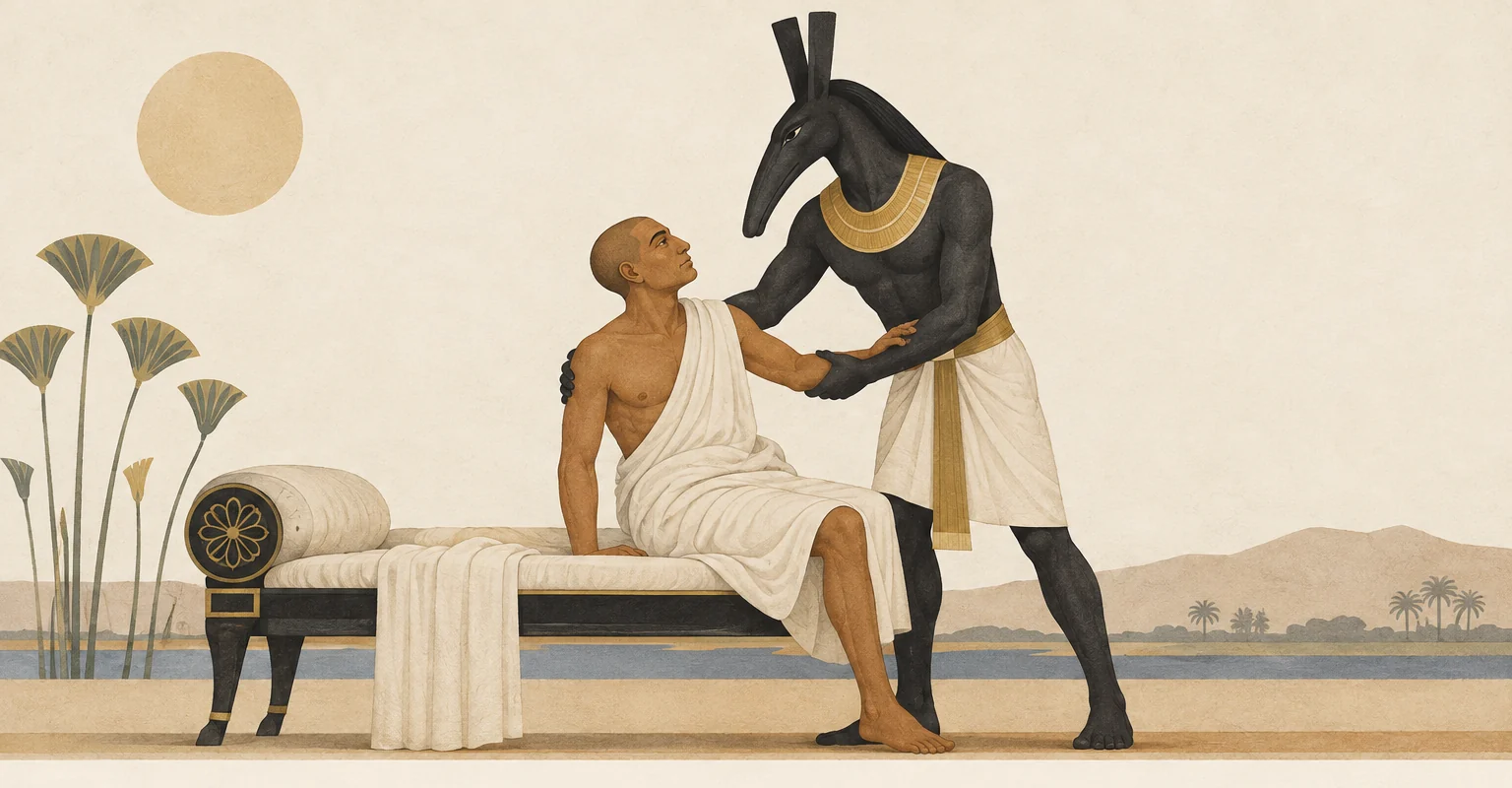
The model of judgment and salvation is followed into later religions, institutions and authorities that speak in the name of the afterlife.
Explore religionsFrom Egyptian funerary texts to a model of judgment, guilt and salvation that continues to operate in the present.
The research reconstructs when and how the fate of the dead changed, and traces the consequences for religion, philosophy, politics and everyday life.
The model of judgment and salvation is followed into later religions, institutions and authorities that speak in the name of the afterlife.
Explore religions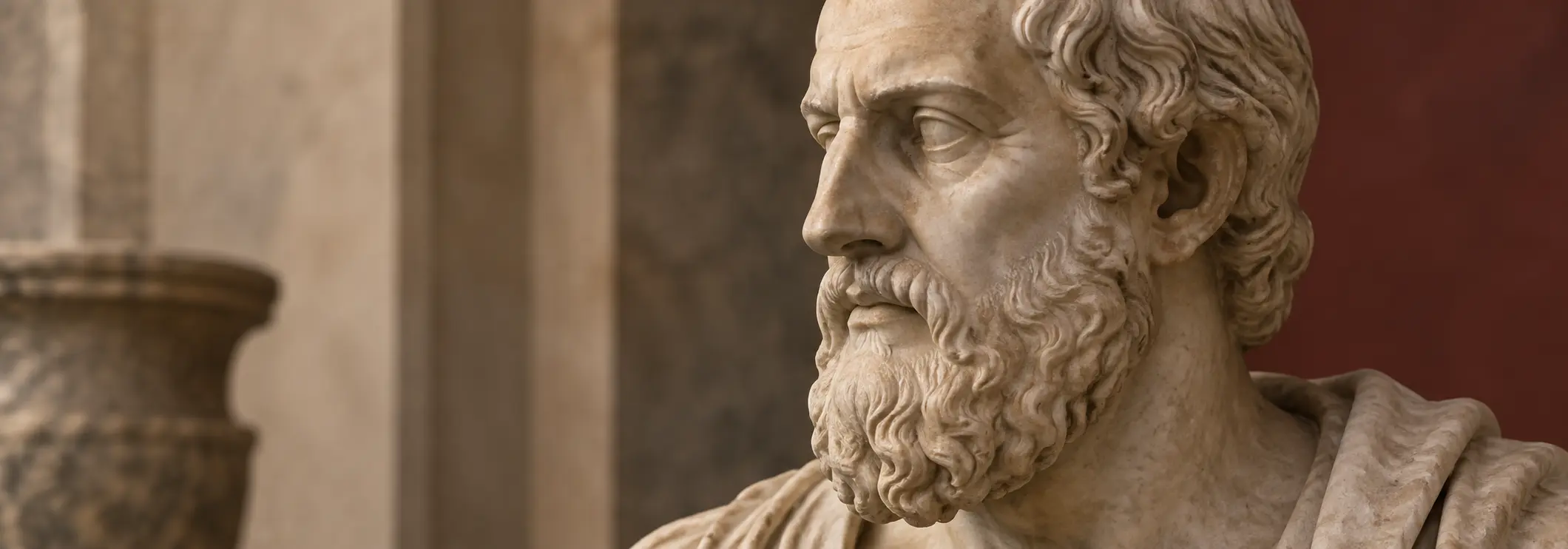
The history of soul, identity, good and evil must be reconstructed before and after Plutarch, without projecting Set–Typhon onto the origins.
Explore philosophy
The structure reappears in religious politics, sacralised wars and the commodification of faith and the afterlife.
Explore our livesIn the oldest written path, death is followed by ascent: the deceased goes upward, reaches Ra and joins the imperishable stars.
Later texts introduce another passage. Osiris governs the dead; access is surrounded by guardians, conditions, justification and judgment. Yet the older route survives inside the newer system.
It entered human life.
death and personal identity
guilt, judgment and salvation
religious authority and political power
wars of God against evil
commodification of faith and the afterlife
Once salvation depends on judgment, an authority can define guilt, innocence and the conditions of acceptance. This pattern reaches education, law, political identity, war and the commodification of faith and the afterlife.
The history of the soul, identity, good and evil must begin before Plutarch. His later equation of Set with Typhon belongs to the reception of the Egyptian tradition, not to its documented beginning.
The familiar family of Isis, Osiris, their son Horus and Set the murderer is a late arrangement projected backward over the whole of Egyptian history.
The family myth is projected backward across all Egyptian history. Gods, judgment and the afterlife appear unchanged for three thousand years.
Osiris is securely attested from the Fifth Dynasty. Isis becomes clearly visible in the earliest Pyramid Texts, at the end of that dynasty. Horus and Set already belong to earlier Egyptian kingship; their relationship did not begin as the later story of a murderous uncle and an avenging son.
The scandal is double: ancient Egypt rewrote its religion. Modern history then hid the rewriting by teaching the final system as though it had always existed.
Limit of the evidence: absence from the earliest surviving record does not prove that nobody knew a name. It does mean that Isis and Osiris cannot be presented as the documented centre of the origins. Chronology, attestations and alternatives are checked in Set Before Osiris and the complete academic verification.
Four groups of texts preserve the direction of the change. Every step links to the working papers, the dated corpus and the full verification dossier.
The Pyramid Texts direct the king toward Ra, the sky and the imperishable stars.
Pyramid Texts · Old Kingdom
Read the documented context →PT 213 states that Ra-Atum does not hand the king to Osiris and denies Osiris power over his heart and mind. The formula was copied for generations.
PT 213 · Unas, Teti, Pepi I, Merenre, Pepi II, Neith
Check the textual seam →CT 491 names watchers of souls and detainers of shadows. The deceased orders them not to detain his ba and has the sky opened to reach Ra.
Coffin Texts 491–500 · Middle Kingdom
Check the textual seam →The Book of the Dead preserves spells against detention in the necropolis. The developed tribunal, weighing of the heart and forty-two assessors belong to the New Kingdom.
Book of the Dead 91–92 and 125 · New Kingdom
Read the chronology →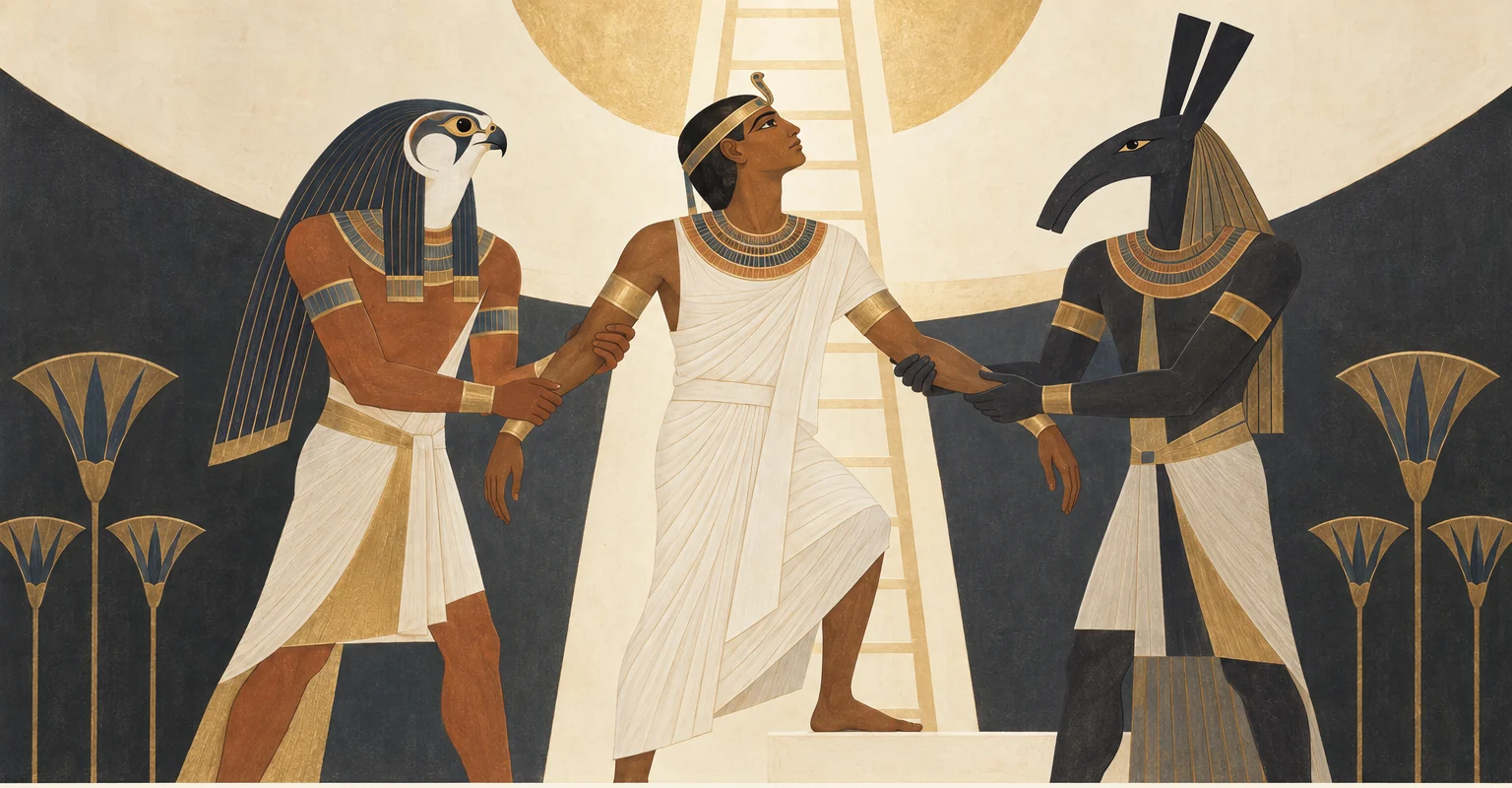
The transformation becomes visible when the later family myth is no longer used as the starting point.
The Horus name is central to royal titulary. Peribsen and Khasekhemwy place Set at the summit of royal ideology before secure attestations of Osiris.
Ra, the sky and the stars dominate the royal programme. Osiris and Isis are not yet securely attested as the original centre of the system.
With Unas the Pyramid Texts preserve solar, stellar and Osirian layers together. PT 213 rejects the king's delivery to Osiris and is copied for generations.
The Coffin Texts bring funerary formulas to non-royal owners. CT 491–500 name guardians and non-restraint while opening the passage to Ra.
The Book of the Dead preserves the ba's exit and mobility, but also Osirian gates, formulas, heart weighing and forty-two assessors.
Proscriptions and defacement are real, yet selective and regional. The Book of Victory over Seth commands his defeat and exclusion.
A late Greco-Roman narrative makes the myth coherent and translates Set through philosophical categories foreign to the earliest Egyptian attestations.
The older path does not vanish. It is absorbed, retold and placed under a new authority.
Horus and Set first appear as royal counterparts; Osirian genealogy turns Set into the murderous uncle.
Set legitimises kings and protects Ra, yet is also punished as Osiris's aggressor.
The personal name remains, but the dead person's status is mediated by a new Osirian classification.
The solar destination survives inside a world now governed by Osiris.
What is first reconstituted within the person later becomes the object of a tribunal.
A direct path from the oldest ascent texts to Osiris, restriction, judgment, Set’s defacement and the impact on later religions.
Date, corpus, manuscript copies, translations, ritual context, later reuse, alternative explanations and the exact source of every claim.
Pyramid Texts, Coffin Texts, Amduat, Book of the Heavenly Cow, Book of the Dead, Contendings of Horus and Set, late Seth rituals, Gnostic texts and Books of Jeu.
The claimed originality is not the discovery of one isolated text. It is the chronological chain linking non-delivery to Osiris, non-restraint, access to Ra, the growth of Osirian jurisdiction, Set's transformation and late reception.
The principal documents are available in English, Italian and Spanish. English remains the scholarly reference edition.
The complete evidentiary chain: sources, chronology, inferences, objections and falsification criteria.
Early royal, solar and funerary functions of Set.
Osiris, mediated identity and the development of judgment.
Contradictions that reveal reuse and rewriting.
From direct transformation to authorised salvation.
The Demiurge, non-human origin and the boundaries of the hypothesis.
How a philosophical intuition was turned into testable questions about the sources.
The documents show what changed. They do not provide one certain answer about motive. That question remains open.
This path challenges the religious structure that grew after Osirianisation: judgment, guilt, granted salvation and authority speaking in the name of the afterlife. It follows that structure into society, openly religious parties, wars fought in the name of God against evil and the commodification of faith and the afterlife, which dictates rules during life.
Question the system →This path explores the Demiurge, the possible non-human origin of the divine figures and the idea of a real post-mortem process. It begins after the historical demonstration and cannot be used to prove it.
Explore the cosmological question →Set matters because his changing image exposes the rewrite. He is an early royal power, assists ascent in funerary texts and defends Ra against Apophis. After losing the royal dispute he is not destroyed: Ra receives him into the celestial sphere. His radical demonisation comes later.
Set’s defacement does not create the proof. It shows how a necessary power from the older order was recoded after that order changed.
Read Set Before OsirisThese images belong to the speculative narrative. They do not document ancient Egypt and are not used as evidence for the historical research.
The path begins with ancient corpora, checks each step against specialist research and keeps the limits of the conclusion visible.
James P. Allen; R. O. Faulkner; Adriaan de Buck; Mark Smith; Bernard Mathieu; Jan Assmann; Herman te Velde; Philip Turner; Jan Arp-Neumann; Colin Hope; Ronald Leprohon; Mariano Bonanno.
Plutarch, De Iside et Osiride; Greco-Egyptian magical papyri; Sethian texts from Nag Hammadi; Books of Jeu; Origen. Late sources are used to study reception, never to project their ideas back into the Old Kingdom.